


Synopsis: In this blog, I refer to my recent experience in France and the need for a new vocabulary to describe our feelings, as we experience unprecedented extreme phenomena due to climate change. Since emotions, positive and negative, move us, I invite us to fully use them to grow our agency and embrace our love for life. (Reading time: 9 min)
Grounding Change in emotions
The most important strategy to manage emotions[1] often starts with naming them.
Finding the right words that encapsulate our experience normalizes and validates what otherwise can feel like diffused threats to our nervous system. It also means we are not the only one to feel what we feel. I remember how calming it was for many of us during Covid to name the state of languishment — a sentiment of stagnation and emptiness – and find a place of acceptance instead of resistance. It provided a chance to appreciate and explore its opposite — the state of flow – when we lose track of time working with discipline and focus on a task that matters.
Part of my job as a coach is to help people make sense of their experiences, name their feelings and thoughts, remove barriers, and most importantly grow their sense of agency – the capacity to act intentionally and have influence over our life’s circumstances, and what we care about.
I was recently reminded that in the face of unprecedented and stunning circumstances, we need new vocabulary to name complex emotions and unlock agency.
I just came back from France that has been going through the longest, hottest, earliest in the season and devastating heat waves, with mega fires and degraded air that have impacted 2/3 of the country.
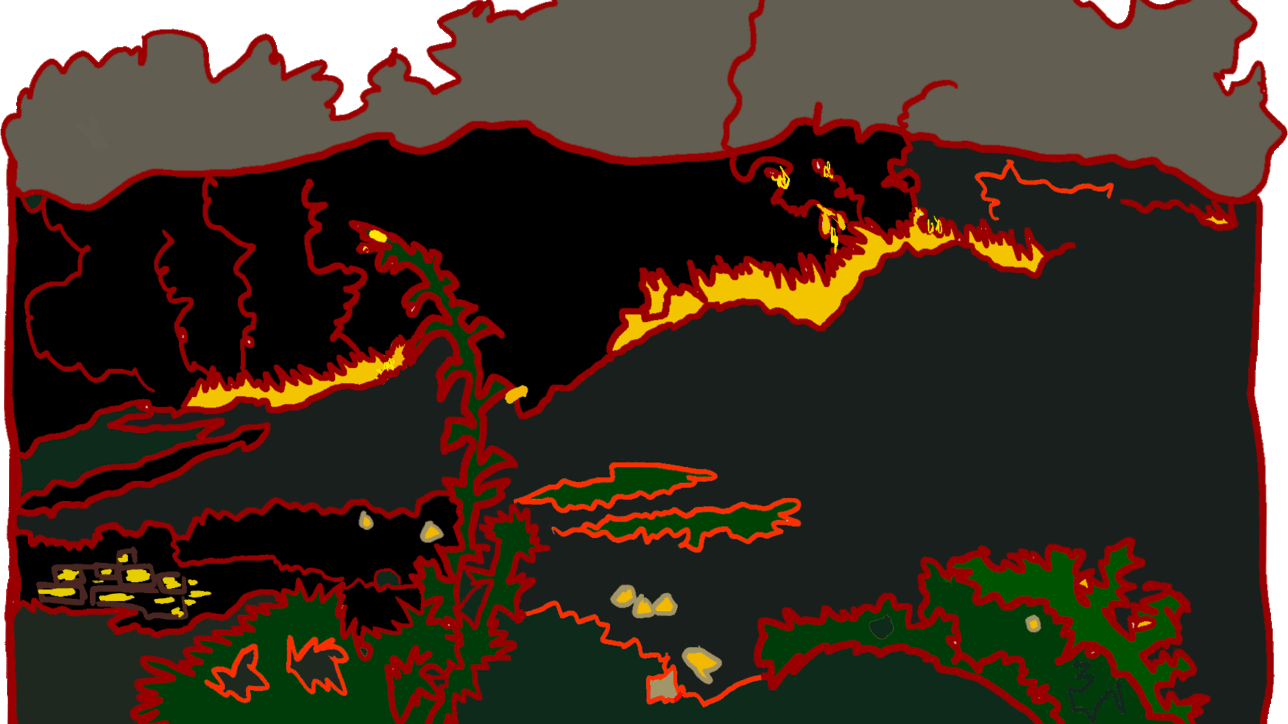
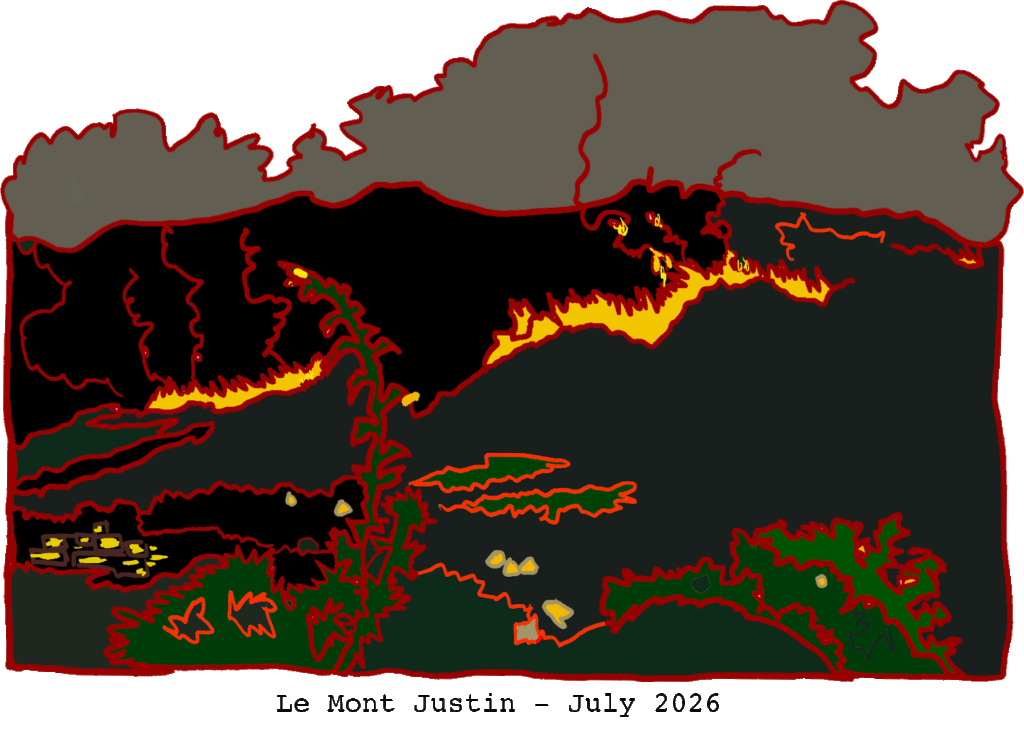
Early July, a little town in the Drôme where I’ve been visiting my mother for 40 years, was on the verge of evacuation. The majestic Mont Justin at the foot of the town, that we’ve been hiking many times, was burning — an unthinkable vision up until this day. Firefighters succeeded to protect the town, but 4400 hectares burnt. Not enough resources to fix the fire, when too many other mega fires were spreading in other parts of France. We had to hurriedly leave the town after Jean-Pierre developed lungs’ inflammation due to the smoke.
Feeling sorrowful, disorientated and bitter, I found solace and grounding in discovering a new vocabulary.
Enriching our eco-vocabulary
Many philosophers, psychologists and mental health professionals are exploring the impact of the climate change crisis on our physical, emotional, spiritual and mental health.
Glenn Albrecht, an Australian philosopher, spent over twenty years inventing new words for the extreme, unprecedented phenomena of climate change and industrial over-development – a vocabulary he calls psychoterratic, naming our deep emotional connection to the state of the Earth.
One word struck a chord.
Solastalgia is Albrecht’s word for the pain of losing a place we love while still living in it – “a type of homesickness we have while at home and our home environment is changing in ways that we find distressing.[2]”
It goes without saying that I felt solastalgia in front of the Mont Justin.
Like many people who have been lucid about climate change issues for the last 30 years, I also felt indignation, and anger in contemplation of the political inertia despite decades of warning.
Sometimes, it’s good news to feel anger rather than resignation — anger moves us toward something; resignation doesn’t.
In 2025, a French rapport from a governmental agency (ADEME) published that 1 in 4 people[3] in France experience eco-anxiety[4]— a generalized fear that the future will keep getting worse.
High eco-anxiety leads to eco-paralysis[5] — an incapacity to act, the very opposite of agency.
Perhaps one silver lining of this devastating summer is to legitimate the feeling of eco-anxiety, not as a pathology but as adaptive behaviors to climate change.
I had to face my own eco-anxiety and examine more deeply my own persistent barriers to agency.
Overcoming individual barriers to agency
As human beings, we have many ways to avoid the discomfort of eco-anxiety and protect ourselves.
Denial is an unconscious defense mechanism in which we refuse to recognize or acknowledge objective facts or experiences[6].
A trick of denial is distance[7] – convincing ourselves the danger is elsewhere or later. Thirty years ago, ‘2050’ sounded like science fiction. It’s 24 years away now. And somehow, I still manage to believe it’s far!
We also protect ourselves with doomerism — a belief, soaked into a feeling of powerlessness, that the world is doomed and that individual action is too small to matter[8].
I’m prone to doomerism. That is deeply annoying to Jean-Pierre and our daughter, Anouk, when I slip an eco-apocalypse line in each of our conversations.
There is a young and loyal part of myself that has adopted catastrophizing – anticipating and preparing for the worst outcomes — as a protector.
In the work of self-awareness and leadership development I do with clients, change starts with naming the patterns that get in the way of exercising leadership. When we learn to get familiar with our patterns, we also learn to turn the wheel and make purposeful choices.
My doomerism has roots I can trace to a single afternoon at five years old – a lie an older boy told me about the end of the world, delivered with terrifying specificity. It didn’t create the pattern by itself; temperament, family context, culture, a hundred other data points contributed to shaping it. But the story crystallized an after-before moment. Since that day, I’ve mostly trusted only my own mind to make sense of danger – which has made me both fiercely self-reliant, anxious — and alone.
I spent a lot of my young adult life unraveling my learned helplessness[9] – the belief that one can’t change their circumstances – and discovered that there is comfort for my ego in holding a dark future and avoiding risk and disappointment. Unraveling that pattern is certainly why I’m so passionate about individual agency.
But I’m not naïve. We need collective movement to put pressure on governments and change policies. And collective movements are made of individuals who had to find their own footing before they could stand with others[10].
I’m working on finding mine. I want to do more than composting, recycling, minimizing my meat consumption, using clean products, eating local food or swapping clothes with girlfriends. I live between two countries – not great for my carbon footprint. So, I’m rethinking my life choices and what truly moves me.
What moves us
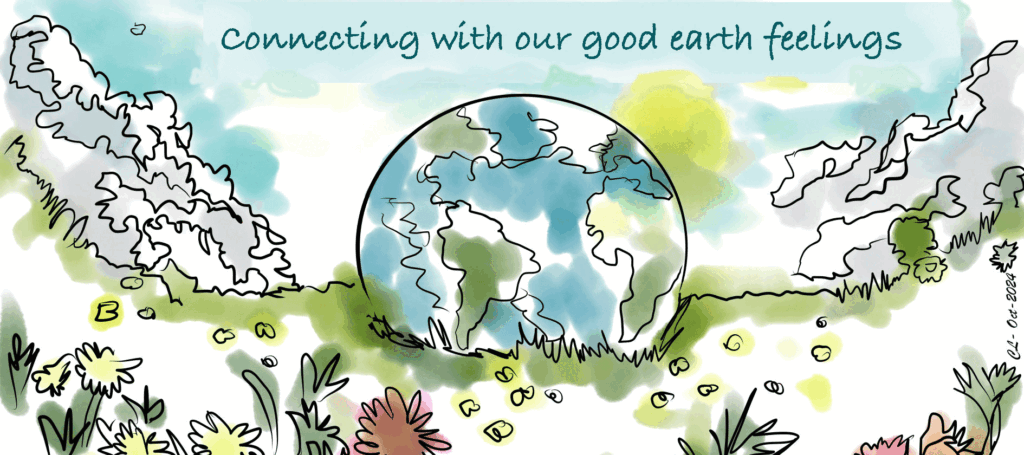
We can be moved by fear, fed-upness, anger and despair, or by love, solidarity and what we deeply care for. These positive feelings are important to nurture, as they are powerful sources of transformation and engagement. They help us stay congruent with who we truly are.
If, like me, you’re a lover of nature, landscapes and biodiversity, you probably have experienced eutierria[11] – a state of harmony we enter, when the divisions between the self and the rest of nature are dissolved.
Eutierria builds on biophilia – a term popularized by Edward O. Wilson for our instinctual love of life, the felt pull toward everything living.
The full expression of positive earth emotions, for Albrecht, is Soliphilia – a political commitment born from the love for our intimate relationships to place, and the willingness to protect them at every scale.
Albrecht proposes to use our good earth feelings in service of an aspiring vision: to replace the current Anthropocene era – an age of attempted human dominance that is leading us toward sickness and extinction — with a new era he calls the Symbiocene[12]: a future state where humans re-integrate with the rest of life in nature, “using bioscience and symbioactive technologies built from and returnable to living systems, that are safe, renewable and non-polluting.”
It sounds jargony and unrealist, but there’s imagination and wisdom behind the invented words. And we need both to find solutions to climate change, develop a shared vision of a better future, and tap into our positive feelings to act.
I hope this piece has enriched your vocabulary and encouraged you to feel your feelings — as a tool to grow your agency and to fully inhabit that same love of life, in this lifetime, on this earth.
Notes
[1] We tend to use emotion and feeling interchangeably, but they are distinct. Emotions originate as sensations in the body. Feelings are influenced by our emotions but are generated from our mental thoughts. Reference: https://www.psychologytoday.com/us/blog/the-pleasure-is-all-yours/202202/the-important-difference-between-emotions-and-feelings
[2] https://theecologist.org/2019/mar/28/symbiocene-emotions
[3] https://www.vie-publique.fr/files/rapport/pdf/298255.pdf
[4] The term appeared in a report in 2017 published by American Psychological Association and ecoAmerica.
[5] https://theconversation.com/les-eco-emotions-les-reconnaitre-et-les-comprendre-pour-mieux-vivre-les-changements-climatiques-247640
[6] https://www.psychologytoday.com/us/basics/denial
[7] https://www.vox.com/videos/2017/4/19/15346442/humans-climate-change-psychology
[8] Karen Golden-Biddle, https://karengoldenbiddle.substack.com/p/what-science-moms-teaches-us-about
[9] Martin Seligman
[10] Read this enlightening blog from Karen Golden-Biddle about Climate agency: https://karengoldenbiddle.substack.com/p/what-science-moms-teaches-us-about-604
[11] https://theecologist.org/2019/mar/28/symbiocene-emotions